
Animal Wisdom
Druidic Animal Lore and the Language of the Forest
1 October 2026 · 12 min read
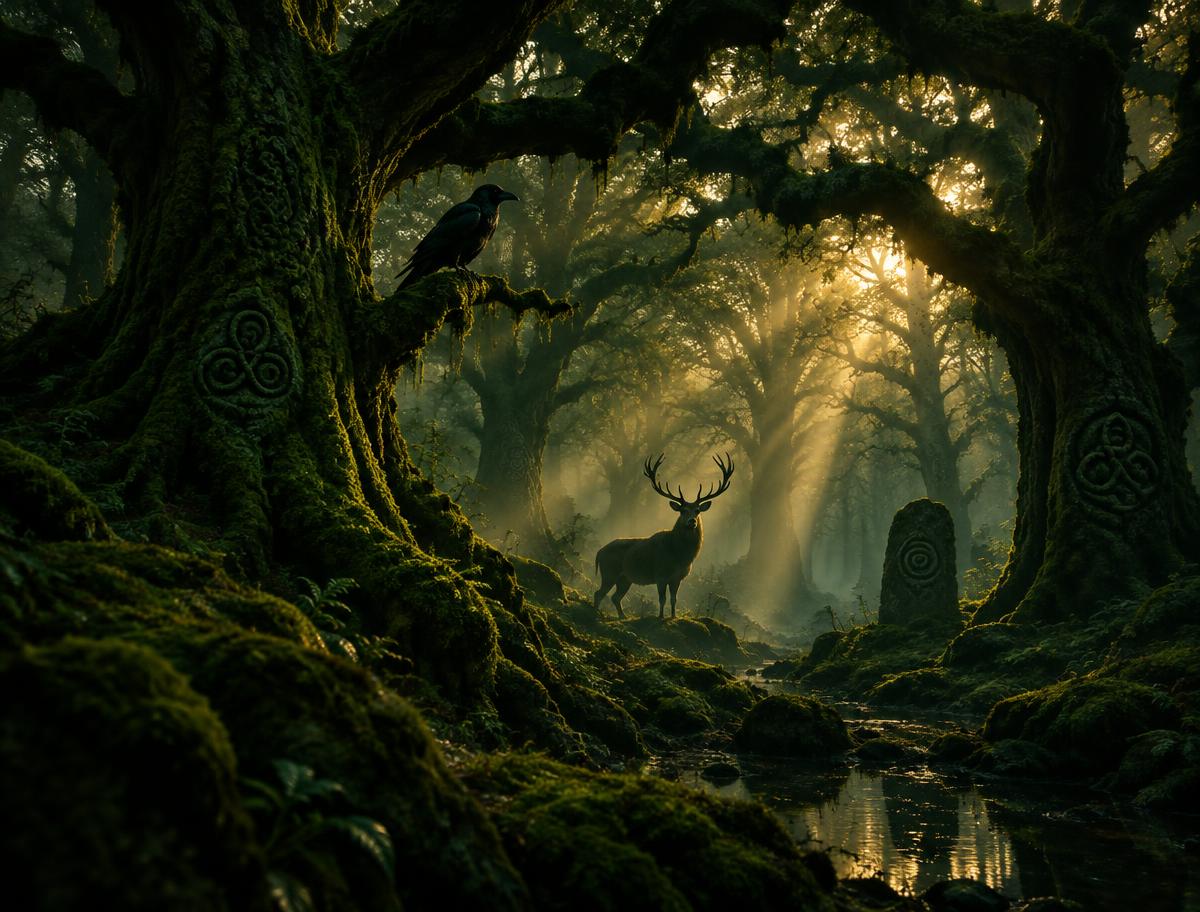
Long before anyone wrote the word druid, people in these latitudes lived inside a conversation. The forest was not scenery; it was a council. A bird's alarm, a path rerouted by deer, the sudden silence of insects — all of it was information, and reading it correctly decided whether a family ate or went hungry. Druidic animal lore is the memory of that literacy, preserved as symbol long after the survival need had faded.
We meet many people who are hungry for this knowledge but reach for it the wrong way round. They want to know what the owl means. The older practice asks a different question: what was happening in you at the moment the owl appeared? Meaning in the druidic sense is not a dictionary entry. It is a meeting between an animal going about its life and a human nervous system that happened to be open.
Three layers of animal teaching
The first layer is behaviour. Before any symbolism, an animal shows you a strategy that works. The fox survives by patience and indirect routes. The deer survives by registering danger without arguing with it. The crow survives by memory and by refusing to forget who harmed it. When an animal becomes insistent in your life, look first at its strategy — it is often exactly the strategy you are refusing to use.
The second layer is mirror. Animals read the field, not the story. A horse does not care what you say about yourself; it responds to the state of your breath and the tension in your intention. This is why horses and dogs become so accurate as diagnostic instruments. If an animal avoids you on a particular day, it is rarely a verdict on your worth. It is a reading of your charge.
The third layer is lineage. In the old teaching, certain animals accompany certain bloodlines. A family that lived by water keeps water creatures in its dreams for generations. A family that survived persecution often carries the wolf — vigilance, loyalty, the inability to rest in open ground. These are not totems you choose in a workshop. They are inherited, and they can be honoured or quietly carried as a weight.
The forest does not speak in words because words can be argued with. It speaks in events, and events must be met.
The language of trees
Trees in the druidic understanding are not symbols of patience; they are the practice of it. Each species holds a different quality of time. Oak is slow authority — it teaches holding a decision long enough for it to become true. Birch is beginning; it colonises burnt ground and shows how to start where everything was destroyed. Willow bends in the direction of grief and does not break, which is why it stands near water and near mourning. Hawthorn guards thresholds and punishes impatience. Yew sits with death without fear of it.
Working with a tree is simple and unspectacular. You choose one you did not choose for beauty, stand with your back to it, and do nothing for the length of thirty slow breaths. Then you notice what arrives — not visions, usually, but a change in posture, a memory you had filed away, a sentence you have been avoiding saying. The tree did nothing mystical. It gave your nervous system a steady reference point, and in that steadiness the thing you were holding down surfaced.
How to read the signs without superstition
A sign has four parts: the event, the timing, your inner state, and the action it asks for. If any part is missing, you are interpreting rather than listening. A hawk crossing your path on an ordinary commute, with no question alive in you, is a hawk hunting. The same hawk on the morning you have decided to say nothing at a family gathering is a direct address: see clearly, speak from height, stop pretending you cannot see what you see.
Keep a thin notebook. One line per encounter: what, when, what I was carrying. Within a season you will stop needing anyone's symbol list, because your own pattern becomes visible. This is the real druidic training and the reason it was never written as doctrine — it is individual, and it cannot be bought.
What the forest asks in return
The relationship is not free. The old practice was built on reciprocity: you take water, you leave something; you take wood, you tend what remains. Energetically the same law holds. If you ask the living world for guidance and then ignore what arrives, the channel closes — not as punishment, but because attention that is never acted on stops being attention. Act once, visibly, on the smallest thing the forest showed you. The conversation reopens immediately.
People often come to us wanting to speak with animals. Almost always the work is the reverse: becoming quiet and regulated enough that an animal is willing to speak with them. That quiet is not a talent. It is a practice, and the forest will teach it to anyone who keeps returning.
Community Circle
Share what moved in you while reading. Comments are read by the practitioners.
Tereza M.
28 September 2026
I walked the same forest for fifteen years and never once asked it anything. That changed this week.
Filip D.
10 September 2026
Beautifully written and surprisingly practical. The listening exercise alone is worth the read.